Nigeria and the United States have signed a framework agreement aimed at deepening American investment in Nigeria’s mining sector and accelerating the development of the country’s estimated $700 billion mineral resources.
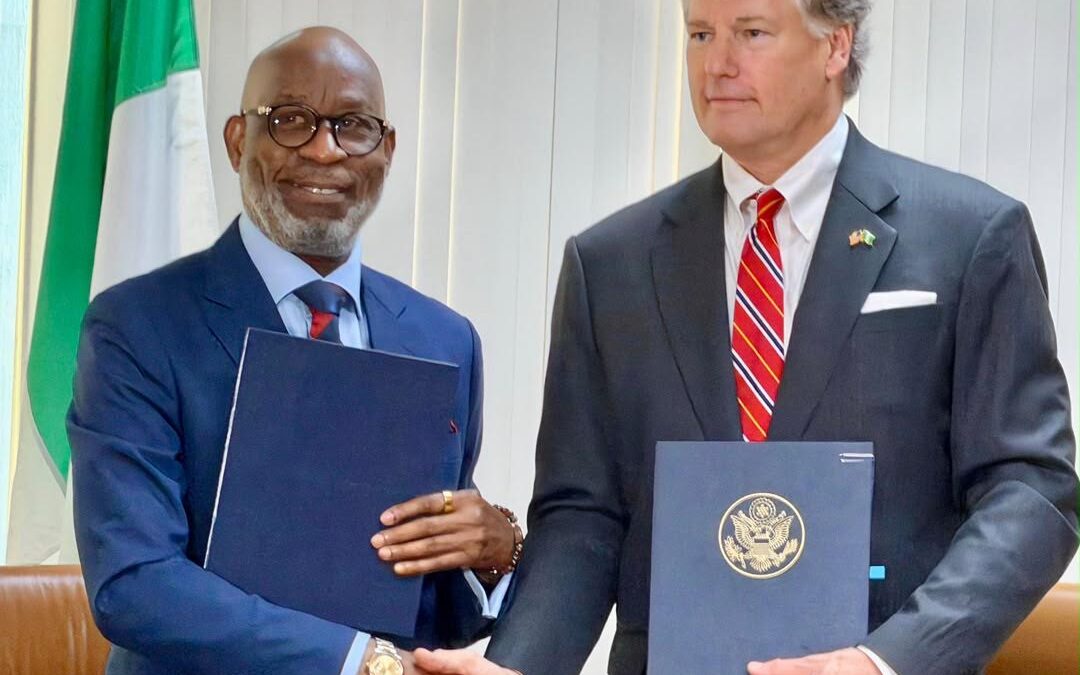
The agreement was signed on Wednesday at the Nigeria Mission House in New York by Nigeria’s Minister of Solid Minerals Development, Dele Alake, and United States Deputy Secretary of State Christopher Landau on the sidelines of the 81st United Nations General Assembly.
According to reports from Reuters and other news organisations, the framework covers cooperation in geological data, mineral exploration, mineral development and processing, infrastructure, and technical capacity building.
Alake said Nigeria wants to move away from exporting unprocessed minerals and instead develop domestic processing capacity that would create jobs, strengthen technical skills and provide greater opportunities for Nigerian businesses.
«“Nigeria cannot remain a source of raw materials while others capture most of the value,” Alake said.»
He added that the government would work with American partners to identify viable projects, mobilise investment and develop commercial partnerships that can generate measurable benefits for both countries.
The agreement comes as Nigeria seeks to attract more foreign capital into its largely underdeveloped mining industry and diversify the economy away from its dependence on crude oil.
The United States is also seeking to strengthen supply chains for critical minerals used in technologies including electric vehicles, renewable-energy systems and other advanced industries. Reuters reported that Nigeria’s emerging lithium industry is among the areas where foreign investment is already increasing, with Chinese companies playing a significant role.
Focus on local processing
A major component of the new framework is Nigeria’s push for value addition within the country.
Rather than simply extracting minerals and exporting them as raw materials, the government wants more processing and related industrial activities to take place locally.
The framework therefore includes mineral processing, infrastructure development and technical capacity building, areas that could support the development of a wider mining value chain in Nigeria.
The agreement also comes shortly after President Bola Tinubu, represented by Vice President Kashim Shettima at a critical-minerals meeting during UNGA, called on African countries to move away from exporting raw minerals and develop local processing and manufacturing capacity.
Agreement now moves to implementation
Alake stressed that signing the framework was only the beginning, saying the next stage would involve identifying viable projects, mobilising investment and developing commercial partnerships.
The US delegation said Washington viewed Nigeria as an important regional partner and was interested in strengthening economic cooperation between both countries.
Nigeria has estimated the value of its mineral resources at about $700 billion, although this figure represents the estimated value of the country’s mineral wealth and not a $700 billion investment commitment from the United States.
The success of the agreement will therefore depend on how quickly it translates into actual exploration activities, mining projects, processing facilities, infrastructure and private-sector investment.
For Nigeria, the government is seeking to use the partnership to turn its mineral resources into greater industrial activity, employment and domestic economic value.