Nigeria has recorded what medical authorities described as West Africa’s first tele-robotic surgery, after surgeons remotely operated on a patient in Abuja to remove a cancerous kidney tumour.
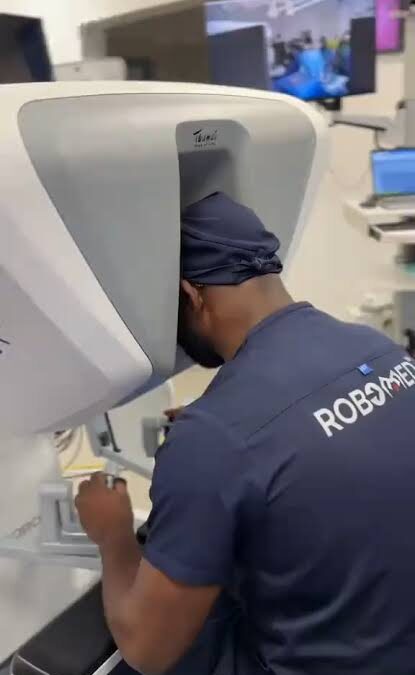
The procedure was performed in real time by the Redeemer’s Health Village (RHV), in collaboration with RoboMed Global and Nisa Premier Hospital, Abuja. The operation took place on Saturday using a Toumai robotic surgery console at RHV, while the patient remained at Nisa Premier Hospital.
The operation involved a robot-assisted right radical nephrectomy, a procedure in which the affected kidney was removed because of a cancerous tumour.
Tele-robotic surgery, also known as remote surgery, allows a surgeon to control robotic surgical equipment from a different location while operating on a patient remotely.
Prof. Obi Ekwenna-Davis, Professor of Urology and Transplantation and co-founder of RoboMed Global, led the procedure. He said the successful operation demonstrated that telesurgery could be used to provide specialist surgical care across different locations.
The surgeon, who is based in the United States, said the patient was in good condition following the operation and was expected to be discharged within 24 hours. The surgery lasted approximately three hours, with brief pauses to confirm that the equipment and communication systems were functioning properly.
The procedure also marked a collaboration between hospitals in different parts of Nigeria, with the surgical team remotely controlling the robotic equipment while the patient remained in Abuja.
Technology Bridges 500-Kilometre Distance
According to reports, the robotic control system at RHV was connected to the equipment at Nisa Premier Hospital through an internet connection, allowing the remote surgeon’s movements to be transmitted to the robotic arms operating on the patient.
The development means specialist surgeons can potentially provide care to patients in locations where particular expertise may not otherwise be readily available.
Dr Adedamola Dada, Chief Executive Officer of RHV, described the procedure as a major milestone for healthcare delivery in Nigeria and West Africa.
He said the technology could help reduce the need for Nigerians to travel abroad for complex medical procedures by allowing specialist expertise to be delivered remotely within the country.
However, Dada identified reliable internet connectivity, appropriate equipment and trained personnel as important requirements for the continued use of telesurgery.
Robotic Surgery Training Planned
RHV and RoboMed Global are also establishing a robotic academy aimed at developing local expertise in robotic surgery.
Prof. Ekwenna-Davis said the academy plans to train at least 150 surgeons over the next two years, while the broader programme is expected to train surgeons, nurses, biomedical engineers and other medical professionals involved in robotic procedures.
The team has also called for government support, including scholarships and training opportunities, to help Nigerian healthcare professionals acquire the skills required to operate and support robotic surgical systems.
Dr Ibrahim Wada, Chief Executive Officer of Nisa Premier Hospital, said the hospital had been involved in robotic surgery since November 2025 and described the latest procedure as an example of what collaboration between Nigerian medical institutions can achieve.
The development adds Nigeria to the growing list of countries using robotic technology to expand access to specialised surgical care, while highlighting the potential of telecommunications to connect patients with specialist surgeons across significant distances.