Nigeria’s oil refining industry recorded its strongest quarterly growth in the second quarter of 2026, expanding by 43.94 per cent year-on-year, as increased operations at the Dangote Petroleum Refinery continued to boost domestic refining activity.
The figure was disclosed in the Q2 2026 Gross Domestic Product (GDP) report released by the National Bureau of Statistics (NBS) on Monday.
The latest GDP report, which contains rebased quarterly estimates, covers Nigeria’s economic performance throughout 2025 and the first two quarters of 2026.
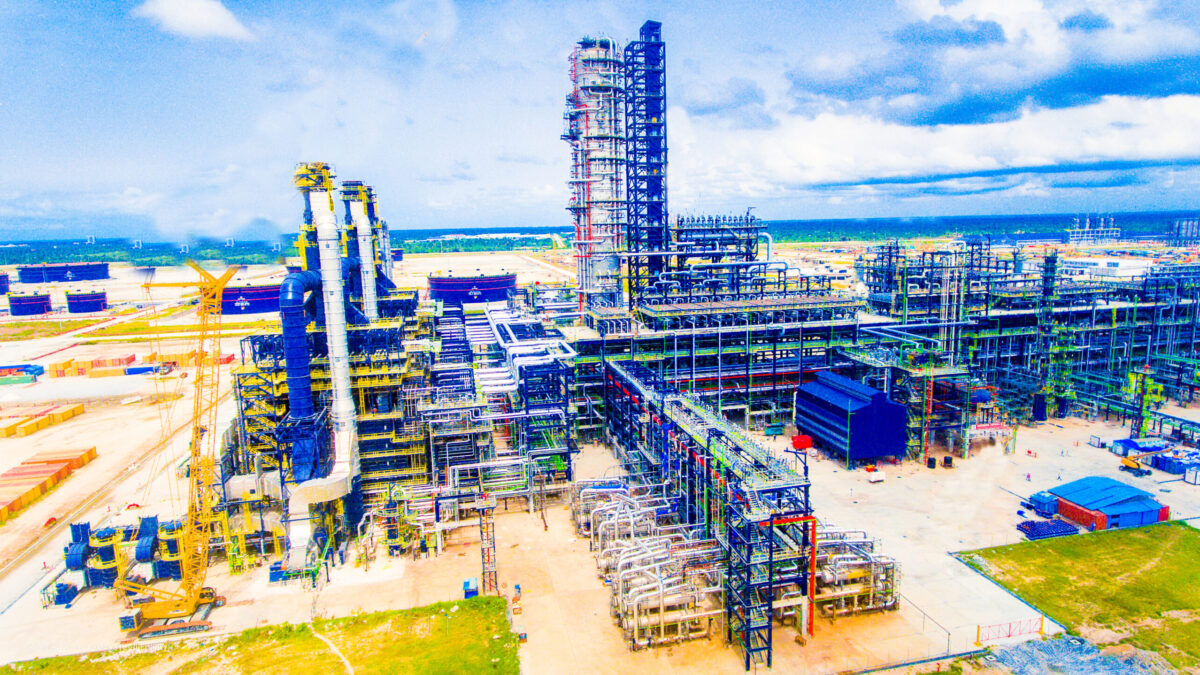
The sharp rise in refining activity coincides with the continued expansion of the Dangote refinery, which completed maintenance and upgrade work in February.
Following the project, the facility’s crude oil distillation capacity increased from 650,000 barrels per day to 700,000 barrels per day, further consolidating its position as a major player in Nigeria’s downstream petroleum industry.
Refining Growth Accelerates
NBS data showed that the refining sector’s performance has strengthened considerably.
Under the rebased GDP series, refining activity recorded growth of 37.46 per cent in the first quarter of 2025, before reaching 43.94 per cent in Q2 2026. This was substantially higher than the 19.42 per cent and 12.33 per cent recorded in the third and fourth quarters of 2024 respectively.
For the full year 2024, the sector recorded growth of 14.08 per cent.
The improvement was also reflected in the sector’s nominal output. The value of refining activity rose from approximately N2.46 billion in Q1 2026 to N5.36 billion in Q2, representing a year-on-year increase of 90.85 per cent.
This compared with a 57.06 per cent nominal increase recorded in the first quarter.
The latest figures represent a significant improvement over the previous GDP series, which placed refining-sector growth at 35.81 per cent in 2023 and 16.67 per cent in 2024.
Dangote Refinery Boosts Domestic Processing
The Dangote Petroleum Refinery has become a major contributor to Nigeria’s expanding refining capacity, with its higher processing volumes helping to increase domestic petroleum production.
Data from the Nigerian Upstream Petroleum Regulatory Commission (NUPRC) indicated that local refineries received 53.7 million barrels of crude oil and condensate between April and June 2026, representing 97.4 per cent of the available domestic supply allocated for the period.
Dangote Refinery accounted for the largest share of crude supplied to domestic refining facilities.
During the quarter, the refinery indicated a requirement for about 63 million barrels, while producers offered 68.1 million barrels. The facility ultimately took delivery of approximately 52.6 million barrels, equivalent to about 78 per cent of the crude offered.
The development marked a substantial improvement compared with Q1 2026, when domestic refineries received only 28.5 million barrels despite 61.9 million barrels being allocated and 68.7 million barrels offered by producers.
The increased supply of crude, combined with the Dangote facility’s expanded capacity, has contributed to higher refined-product production and a changing pattern in Nigeria’s petroleum trade.
Nigeria’s Oil Sector Also Expands
The strong performance of refining activity came against the backdrop of wider growth in Nigeria’s petroleum industry.
Crude oil production averaged 1.72 million barrels per day in Q2 2026, compared with 1.68 million barrels per day during the corresponding period of 2025 and 1.55 million barrels per day in Q1 2026.
The broader oil sector grew by 7.31 per cent year-on-year during the quarter. Although this was below the 20.46 per cent growth recorded in Q2 2025, it represented a notable improvement from the 2.57 per cent expansion recorded in Q1 2026.
On a quarter-on-quarter basis, the oil sector expanded by 10.91 per cent.
Its contribution to Nigeria’s real GDP also increased to 4.16 per cent, compared with 4.05 per cent in Q2 2025 and 3.92 per cent in Q1 2026.
Refining Capacity Supports Petroleum Exports
Nigeria’s growing refining capacity is increasingly affecting the country’s petroleum trade, with refined products now being shipped to international markets in larger volumes.
According to data from the US Energy Information Administration (EIA), Nigeria’s seaborne petroleum-product exports averaged approximately 350,000 barrels per day in Q2 2026, compared with an annual average of 46,000 barrels per day in 2023.
Total seaborne petroleum-product shipments averaged 561,000 barrels per day during the quarter.
Europe received approximately 130,000 barrels per day, compared with 40,000 barrels per day in 2025 and just 15,000 barrels per day in 2023.
African destinations accounted for nearly 120,000 barrels per day, while around 110,000 barrels per day went to markets in Asia and Oceania.
Nigeria Records Stronger GDP Growth
The development in the refining industry formed part of a broader improvement in Nigeria’s economic performance.
The country’s real GDP expanded by 4.43 per cent year-on-year in Q2 2026, compared with 4.23 per cent recorded in Q2 2025.
The non-oil sector grew by 4.31 per cent during the quarter, up from 3.64 per cent in Q2 2025 and 3.94 per cent in Q1 2026.
Despite the stronger oil-sector performance, the non-oil economy remained the dominant contributor to real GDP, accounting for 95.84 per cent of economic output during the quarter.
The latest refining figures highlight the growing role of large-scale domestic refining in Nigeria’s petroleum industry, particularly as increased crude processing capacity supports both local supply and the country’s emerging position as an exporter of refined petroleum products.